Computer vision · 3D measurement
Stereo Truck-Load Volume Estimation
A calibrated stereo workflow for estimating the volume of material in a truck bed when parts of the load surface are out of view.
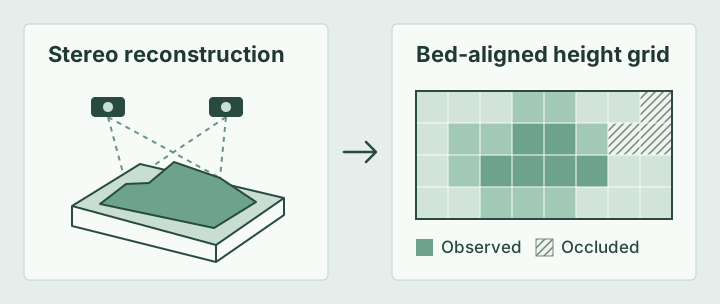
Reconstruct in meters and register to the bed
Camera intrinsics and the relative pose of the stereo pair turn matched image points into metric 3D points in the camera frame. A separate registration aligns that reconstruction with the truck bed. The bed floor defines zero height, and the bed footprint determines which cells contribute to the estimate.
Integrate the surface over the footprint
A 2.5D grid represents the load as one height per cell above the bed floor. Summing each cell’s height times its area gives the volume estimate. For occluded regions, the project compared nearest-neighbor, inverse-distance weighting (IDW), radial basis function (RBF), Gaussian process (GP), and biharmonic interpolation. Tracking which cells were inferred made it possible to assess how much the estimate depended on filling gaps.
Evaluate gap filling and check the geometry
Masked holdouts hid portions of the observed surface so interpolated heights could be compared with the withheld observations. Geometry checks examined the floor alignment and bed footprint. Together, these checks assessed interpolation where observations were available and highlighted uncertainty where occlusions left little support.
Bed registration was the principal bottleneck
A misplaced or tilted floor shifts height estimates across many cells, and a misaligned footprint changes which cells are counted. Those errors can carry through to the total even when local surface interpolation is consistent.